← Back to Home Security Hardening
Physical security
How to Reinforce a Door Against Kick-Ins
Some links on this site may earn us a commission, at no cost to you. It never decides what we recommend. How we make money.
Most doors don’t fail at the lock. They fail at the frame, where a few short screws hold the strike plate to a thin strip of wood. A better deadbolt helps, but anchoring the hardware into the framing is what actually stops a kick.
This is one part of our home security hardening guide, which covers lighting, cameras, alarms and the rest of the house.
Start with a commercial grade deadbolt
Use commercial grade deadbolts with some pick protection and stronger internals. Get them keyed alike, so one key works every door in the house. The Schlage B560P is a good example, and it comes with a security strike box.
Our pick
Schlage B560P deadbolt· Schlage
A commercial deadbolt with a security strike box included.
Downside: It's rated ANSI Grade 2, not Grade 1. The strike box and long screws below do most of the work, so don't skip them. If the deadbolt you have is solid, keep it and reinforce the frame instead.
What good looks like: a commercial grade deadbolt, pick protection, and the option to key every door alike.
Don’t bother locking the handle
Locking the door handle adds very little security. Mostly it raises your odds of locking yourself out when the door closes behind you.
Think about how a door actually gets kicked in. If the deadbolt is thrown, nobody is holding the handle open, so the latch is engaged whether the handle is locked or not. The deadbolt and the frame are doing the work.
Anchor the strike plate and hinges into the stud
The short screws that come with hinges and strike plates only bite into the door jamb, or a shallow bit of the door. The jamb is a thin board and splits easily. Long screws reach through it into the wall stud behind, which is what takes the force of a kick.
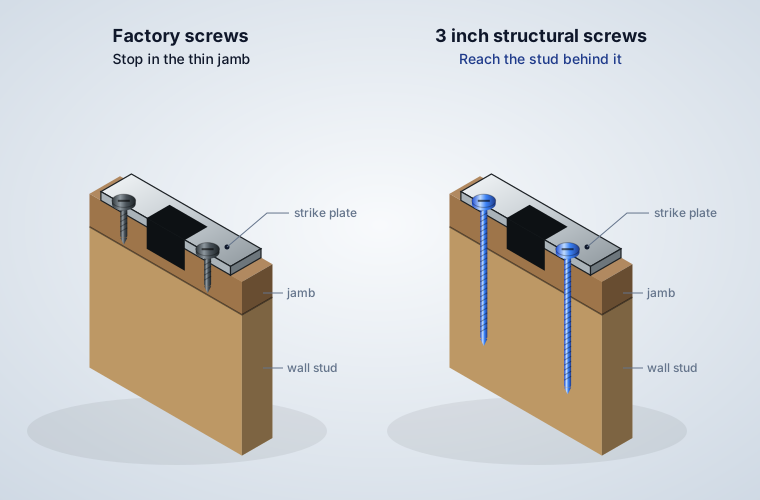
- Use a security strike box for the deadbolt. It replaces the flat strike plate with a deeper, stronger housing for the bolt. The B560P comes with one, or you can buy one on its own.
- Replace the strike screws with 3 inch structural screws. Use the kind actually made to bear load. Regular screws shear under the force of a kick.
- Do the hinges too. You only need to swap one or two screws per hinge, on both the frame side and the door side.
Snug the screws down, but don’t overdrive them. On some frames, cranking a long screw too hard pulls the jamb toward the stud and makes the door bind.
Screws we'd use
GRK R4 multi-purpose screws· GRK Fasteners
Multi-purpose screws approved for structural use, which covers the load a kick puts on the frame. The head sits flush, and the #9 size is strong without being too thick. Pick a length that reaches the stud, about 3 inches.
Downside: They cost more per screw than ordinary wood screws, though one door only needs a handful.
What good looks like: a security strike box, and 3 inch structural screws reaching the framing at the strike and every hinge.
Add a door security bar for nights and trips
For a door you want extra backup on, like the front door at night or any door while you’re away, a security bar braces it against the floor or the frame.
What good looks like: a bar that fits your door and floor, and is quick enough to set that you’ll actually use it.
Block the track on sliding glass doors
Sliders are easy to overlook, and the factory latch on many of them is light. A bar or a cut dowel in the track keeps the door from sliding open even if the latch gives. A pin lock on the frame adds another cheap layer.
What good looks like: something that physically blocks the track, not just another latch.
Deadbolt the door from the garage
The door from the garage into the house deserves the same treatment as your front door. If it has no deadbolt, add one and use it every night. Our guide to securing a garage door covers the garage itself.
Rekey when you move in
If you just moved in, rekey or replace the locks. You don’t know who has a copy of the old keys, and rekeying is cheap compared to finding out.
What good looks like: a kit that matches your lock brand, or new keyed-alike deadbolts if you’re replacing them anyway.