Physical security
Home Security Hardening: The Complete Starting Guide
Some links on this site may earn us a commission, at no cost to you. It never decides what we recommend. How we make money.
Nobody can make a house completely secure, and you don’t need to. The goal is to be one of the less attractive houses in the area for the bad guys. Think in layers: things that put intruders off, things that make getting in harder, things that tell you when someone does get in, and a few habits that reinforce the rest.
Where to start
If you’re doing this in order of effort and payoff:
- Reinforce your doors: better deadbolts and longer screws.
- Secure the garage and the door from it into the house.
- Add exterior lighting, then a doorbell camera or cameras.
- Add an alarm for the doors and windows the cameras can’t see.
- Protect the internet and power those systems depend on.
- Build the habits: no trip posts, lights on a schedule, a safe for the important stuff.
Make it harder to get in
Doors and locks
Most of the real hardening happens at the doors, and most doors fail at the frame, not the lock. Three changes cover it:
- A commercial grade deadbolt with pick protection, keyed alike across the house.
- A security strike box, with 3 inch structural screws through the strike and hinges into the wall stud.
- A security bar for nights and trips, and a bar or cut dowel in the track of any sliding glass door.
Our pick
Schlage B560P deadbolt· Schlage
A commercial deadbolt that comes with a security strike box, so one purchase covers the lock and the strike.
Downside: It's rated ANSI Grade 2, not Grade 1. The frame work matters more than the grade, so don't skip the screws. If the deadbolt you have is solid, keep it and reinforce the frame instead.
Our guide to reinforcing a door against kick-ins walks through each step with a diagram, plus why locking the handle doesn’t matter and when to rekey.
What good looks like: a commercial grade deadbolt, a security strike box, and 3 inch screws into the framing.
Garage door
An intruder can open many garage doors in seconds with a coat hanger by pulling the emergency release. An automatic lock that works with your opener stops that.
Lock out the remotes at night and keep remotes out of cars parked outside. Even then, treat the garage as a lower security zone than the rest of your house, and put a deadbolt on the door from the garage into the house, so getting into the garage doesn’t mean getting into the house. Our guide to securing a garage door covers each one.
What good looks like: a lock that works with your opener automatically, and a lockout button on the opener.
Windows
Security film is mostly sold to commercial buildings, but some companies install it on homes. If you go that way, make sure the installer glues the film edges to the frame. If they don’t, a broken window just comes out in one piece.
Roses or other thorny shrubs under windows make them a lot less appealing to climb into.
Window locks or pins add a second barrier on windows that open.
What good looks like: film bonded to the frame at the edges, secondary locks on any window that opens, and thorny plants under ground floor windows.
Backup key
Don’t hide a spare key under the mat or a rock. Use a lock box instead, and mount it somewhere discreet like inside a fake electrical box. Skip push button boxes and the ones with three number or letter dials, because both are easy to pick. A box with a rotating dial is better.
Our pick
Kidde Keysafe Permanent 5-Key (spin dial)· Kidde
A wall-mounted spin dial lock box, the kind we’d pick over push button boxes. It can be hidden under a 1-gang non-metallic outdoor electrical cover, such as the TayMac MM410G, so it’s less obvious what it is.
Downside: It holds up to 5 keys and nothing bigger, and Kidde's product page doesn't state a weather rating, which is another reason to keep it under a cover. A hidden box only slows someone who finds it. The free alternative is a spare key with a neighbor you trust.
Deter and detect
Exterior lighting
If you have no exterior fixtures, get them installed. Use motion activated lights where you don’t want light all night, and dusk to dawn fixtures where you do.
Light the places an intruder would use to hide or stage a break in, or spend time working on a door. That means doors, gates, windows and the backyard, which people forget. If you already have fixtures, dusk to dawn bulbs are an easy upgrade. Where you have no wiring, like a side yard or a gate, solar motion lights are the easy answer.
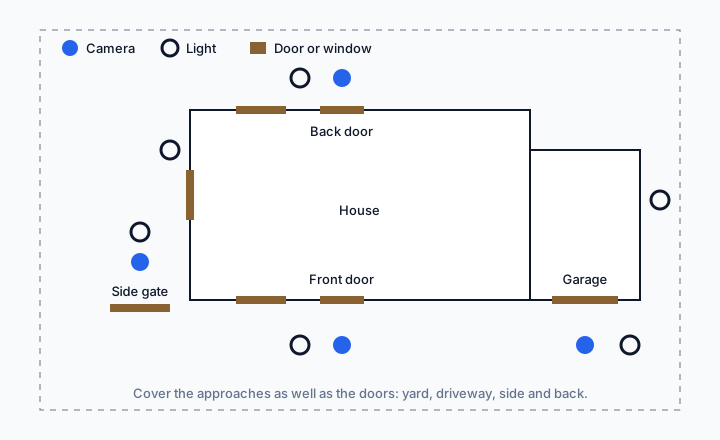
What good looks like: motion sensing where you want it, dusk to dawn sensing where you don’t, and coverage of every entry point and the back of the house.
Cameras and doorbell cameras
Cameras do three jobs. They deter, they alert you, and afterward they give you evidence. They also work as an early warning that something is off, which gives you time to get ready.
Skip cameras inside the house, for privacy reasons. Outside is a different story: cover every entry point and every approach to the house. If you want more deterrent value, pick cameras that announce they’re recording.
If you only buy one, make it a video doorbell. The front door is where you’ll see the most visitors, deliveries included, and it’s the entry point you most want covered.
Before picking a brand, decide where footage is stored and what you’ll pay each month. Many cameras lose recording or smart alerts if you stop paying for the plan. Cameras that record locally, to a card or a hub, keep working without one.
Our pick
The easiest to install and set up, with doorbells, cameras and an alarm that work together in one app.
Downside: Recording needs a paid plan. In 2023 the FTC found Ring let employees and contractors view customers' private videos; turn on end-to-end encryption in the app if your devices support it.
If privacy matters more to you than easy setup, pick cameras that record locally and offer end-to-end encryption. The FTC’s Ring case shows why that matters for any cloud camera.
What good looks like: coverage of every entry point and approach, local recording or end-to-end encryption, and a clear idea of what the subscription costs.
Alarm system
An alarm covers what cameras don’t: windows and doors you can’t see, plus motion sensors inside. Ring sells a DIY alarm that adds on to its cameras.
If you already have a wired alarm, say one that came with a house you bought or one you stopped paying monitoring for, you can often bring it back to life with an add-on board instead of a new system.
For an existing wired alarm
EnvisaLink 4· EyezOn
Connects an old wired panel to your network and phone with no monthly fee, so all the sensors already in the walls go back to work.
Downside: Works only with supported DSC PowerSeries and Honeywell Vista panels, and setup suits people comfortable with technical configuration.
What good looks like: sensors on the doors and windows your cameras don’t cover, and a siren loud enough to matter.
Keep it all working
Internet and power
Cameras and alarms depend on internet and often power, so make sure an intruder can’t cut either in a few seconds. Lock the outdoor electrical panel, put the router on a battery backup and hide it, and add backup internet that takes over on its own.
Our guide to backup power and internet for security cameras covers each layer and how to test it.
What good looks like: failover that needs no action from you.
Don’t advertise that you’re away
Don’t post on social media that you’re leaving for a trip. Put lights on smart plugs with a schedule so the house looks lived in. Ask a neighbor to take in packages and bring in the trash cans, so nothing sits outside for days.
If someone gets in anyway
Keep passports, backup drives, and spare cash and documents in a safe, not a drawer. A fire-rated one covers fire too. Bolt it down, or it can be carried out the door.